
Gutter repair in Lewiston, ID
Most gutter repairs come down to one of four things: a leaking corner or seam, a run that has lost its slope, hangers that have pulled loose, or damage from wind, ice, or a falling limb. Lewiston Rain Gutters fixes all four on homes and commercial buildings across Lewiston.
What you see and what's usually wrong
The fastest way to figure out what a gutter needs is to watch it during a rain, or look at what the rain left behind. Each symptom below points to a short list of likely causes, and most of them can be fixed without replacing the gutter.
| What you see | Usual cause | Typical repair |
|---|---|---|
| A steady drip from an inside or outside corner | Sealant in the mitered corner has dried out and split | Strip old sealant, clean to bare metal, reseal |
| Drips from the end of a run | End cap seal failed or the cap has worked loose | Reseat and rivet the cap, then reseal |
| A visible dip in the gutter, with water standing in it after rain | Hangers have pulled out or bent, or the run was never pitched right | Rehang on new hangers and reset the slope |
| A gap between the back of the gutter and the fascia board | Spikes backed out, or the fascia is too soft to hold a fastener | New hidden hangers screwed into solid wood; fascia repair if the board is rotted |
| Water spilling over the front in one spot during every rain | That section slopes away from the outlet, or a roof valley overloads it | Re-pitch the run, add a downspout, or add a diverter at the valley |
| Dark stripes or peeling paint on the fascia below the gutter | Water getting behind the gutter instead of into it | Check drip edge and gutter position; reset the gutter tight under the roof edge |
| Water bursting out of a downspout joint | A clog at the elbow, or sections assembled upside down so joints point up | Clear the clog and reassemble so each upper piece fits inside the lower one |
| A downspout hanging loose or lying on the ground | Straps or fasteners failed, or it was hit | Reattach to the outlet and strap it to the wall |
| Rust spots or pinholes in the trough | Older galvanized steel gutters that have held water for years | Patch small spots; widespread rust usually means replacement |
| A crushed or kinked section | A ladder leaned on the gutter, a fallen limb, or sliding snow | Reshape if minor; replace the run if the trough is creased |
If several of these show up at once on an older system, it's worth reading our guide on whether to repair or replace your gutters before spending money on a long list of fixes.
How a gutter repair is done
A good repair starts by finding the real cause. Water travels. It can run along the inside of a gutter, or behind it, before it drips, so the wet spot and the leak aren't always in the same place.
-
Look and test
The gutter is checked from a ladder along its length, and water is run through it to see exactly where it leaks, ponds, or overflows.
-
Clean the repair area
Sealant won't stick to dirt, oxidation, or old caulk. Joints that are being resealed are scraped and cleaned down to bare metal first.
-
Fix the cause
That can mean resealing corners and end caps, replacing spikes with hidden hangers screwed into the fascia, resetting slope with a string line, patching small holes, or reattaching downspouts.
-
Check the wood behind it
If a fastener spins or the board feels soft, a new hanger won't hold. That spot needs fascia board repair before the gutter goes back up.
-
Test again
Water is run through the repaired run to confirm it drains to the outlet without dripping or standing.
Repairing part of a seamless gutter
Because a seamless run is one piece, a small dent or hole can usually be repaired in place. A run that's badly bent or creased is a different story: cutting out the damaged part and splicing in a new piece adds a seam, and a seam is exactly what seamless gutters are supposed to avoid. In that case, forming a new run to the same length is often the better fix.
How much slope a gutter needs
A gutter needs a small, steady fall toward its outlet. A common guideline is about a quarter inch over every 10 feet. Too little and water sits in the trough. Too much and the gutter looks crooked against the roofline and can overshoot at the outlet in a hard rain.
How long it takes
Resealing a few corners or rehanging a sagging section is usually a few hours of work. Jobs that turn up rotted fascia, or that involve replacing a full run, take longer.
Before we arrive
If you can, take a photo or short video of the problem during a rain. It shows exactly where water is escaping. Clear cars and patio furniture away from the area under the gutter, and keep pets inside while the ladder is up.
Pricing a gutter repair: spots, height, and the wood behind it
A gutter repair is priced on how many problem spots there are, how hard they are to reach, and what turns up behind the gutter. A single leaking corner on a one-story house and a sagging second-story run on rotted fascia are very different jobs.
- Number of repairs: one corner versus every joint on the house
- Height and roof pitch: second-story eaves and steep roofs take more setup
- Condition of the fascia: soft wood has to be replaced before anything is reattached
- Size of the damaged section: a patch versus forming a new full-length run
- Material: copper repairs are soldered, which takes more time than sealing aluminum
- Downspouts and drainage: adding an outlet or rerouting water adds parts and labor
We give you the price after we have looked at the gutters. If the repair list starts to approach the cost of new gutters, we'll tell you so, and you can compare it with new seamless gutters before deciding.
Why corner leaks keep coming back in Lewiston
Lewiston summers are hot enough to work gutter sealant hard. The city averages about 42 days a year at 90°F or above and close to 8 days at 100°F or above, based on NOAA's 1991 to 2020 climate normals. A metal gutter in direct sun gets hotter than the air around it.
Every hot afternoon and cool night, an aluminum run grows and shrinks a little. The corners and end caps are where that movement is concentrated, so that's where sealant cracks first. On long runs facing south or west, it's normal to see corner leaks return after several summers even when the original work was done right.
What that means for you: check the corners each spring before the wet months, and reseal them as soon as they start dripping. Catching a corner when it first weeps is a quick fix. Leaving it for years lets water soak into the fascia behind it, and that turns a sealant job into a carpentry job.
Gutter damage that shouldn't wait for morning
Most gutter repairs can be scheduled. A few can't, because the gutter itself has become a hazard or water is heading straight into the house. For these, call us at any hour and we'll tell you how soon we can get there.
- A run has torn loose in the wind and is hanging or swinging over a doorway, walkway, or driveway
- A gutter or downspout has come down near the electrical service drop or meter. Stay clear and call your electric utility first.
- A downspout has been knocked off during a storm and the full roof runoff is dumping against the foundation or into a window well
- Ice and packed snow are pulling the gutter down off the fascia
- Water is running behind the gutter and showing up inside on a ceiling or wall
What to do until we get there
Keep people, pets, and cars out from under any loose section. If a hanging gutter can be reached safely from the ground, you can tie it back with rope, but don't climb a ladder in wind, rain, or ice to do it. A tarp or bucket under the worst overflow buys time if water is heading into a window well.
Call (208) 858-8002Ice dams, icicles, and heat cables
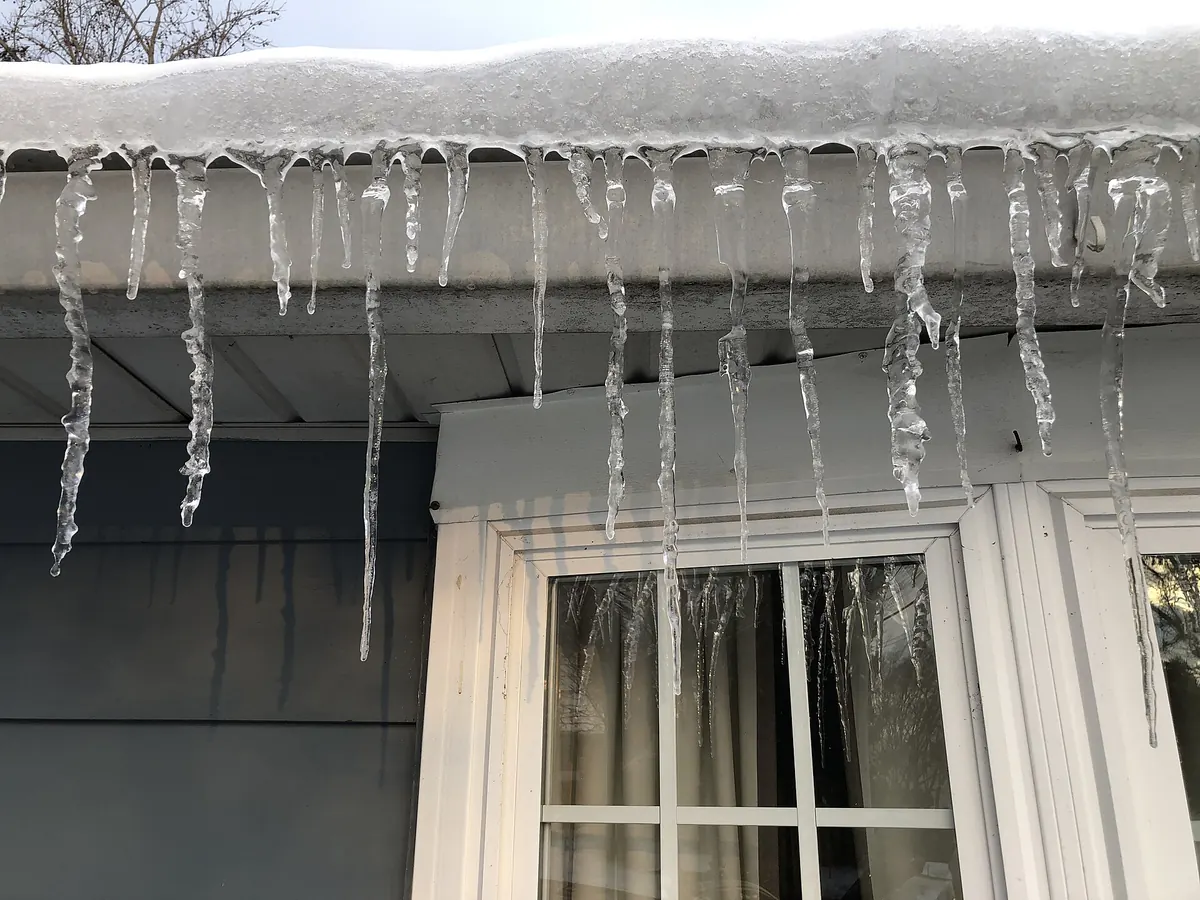
An ice dam is a ridge of ice along the roof edge that traps meltwater behind it. It forms when heat from the house melts snow higher on the roof, and that water refreezes when it reaches the colder eave and the gutter. The trapped water can back up under shingles and into the house.
In Lewiston's valley, most winters bring only about two weeks of days that never get above freezing, so ice dams show up some winters, on some roofs. When they do show up, they show up on the same spots: shaded north-facing eaves, low-slope sections, and parts of the roof over poorly insulated or poorly vented attic space.
Signs you have an ice dam problem
- Thick icicles along one stretch of eave while the rest of the roof is clear
- A gutter packed solid with ice
- Water stains on a ceiling or upper wall near an outside wall after a thaw
- A gutter that sags or has pulled loose after a cold spell
How heat cables help, and where they don't
Heat cables are run in a zigzag along the lower edge of the roof and then through the gutter and down the downspout. They don't clear the whole roof. Their job is to keep a melted channel open so water can drain off instead of backing up. They plug into a ground-fault protected outdoor outlet and are turned on during freezing weather.
We install heat cables on the specific runs that ice up, not around the whole house. If ice damming is widespread, the real cause is usually heat escaping into the attic, and attic insulation and ventilation are worth looking at before buying cable for every eave.
Never chip ice off a gutter with a hammer or shovel. It damages the gutter and the shingles. If ice has already bent or pulled down a gutter, that's a repair we can handle once it's safe to work on.
After a repair: what to watch
Look at the repaired spot during the next real rain. Water should flow to the outlet and leave the corners dry. A small amount of standing water, less than about a quarter inch, is normal in some gutters. Deeper pooling means the slope still needs attention.
Keep an eye on the fascia below the repair over the next few months. New stains mean water is still getting behind the gutter.
When a related service makes sense
Many repair calls trace back to clogs, so a gutter cleaning is often the first step. If overflow keeps hitting the foundation after the gutter is fixed, the problem may be where the water goes next, and extending downspouts or adding a drain line solves it. We repair gutters anywhere in Lewiston; see the areas we cover.
Gutter repair questions
Can a leaking corner on a seamless gutter be fixed?
Yes. Corners on seamless gutters are separate mitered pieces joined with sealant and fasteners, and that sealant is what fails. Stripping the old sealant, cleaning the metal, and resealing usually stops the leak.
Why do my gutters keep pulling away from the house?
Older gutters often hang on long spikes driven through the gutter into the fascia, and those spikes work loose over time. If the gutter keeps pulling away even after new fasteners, the fascia board behind it is probably soft and needs to be repaired first.
Is it worth repairing old sectional gutters?
If the problem is one or two joints, yes. If every joint leaks, the gutters sag in several places, or the metal is rusting through, repairs tend to become a yearly expense, and replacing them with seamless gutters is usually the better use of the money.
Can you replace just one damaged section of a seamless gutter?
Usually the whole run on that side of the house is replaced, because splicing a new piece into a seamless run adds a joint that can leak. Small dents and holes can often be repaired in place without replacing anything.
Can I call about storm damage in the middle of the night?
Yes. We answer the phone 24 hours a day, 7 days a week. Tell us what's hanging or leaking and we'll tell you how soon we can get there and what to do in the meantime.
Do I need heat cables on every gutter?
Rarely in Lewiston. Ice dams here tend to form on the same few shaded or low-slope spots, so cables on those runs are usually enough. If ice forms all around the house, attic insulation and ventilation are the bigger issue.
Get a leaking or sagging gutter fixed
Call Lewiston Rain Gutters at (208) 858-8002 and describe what the gutter is doing: where it drips, where it sags, or what came loose. We'll set up a time to look at it and give you a price for the repair.
Call (208) 858-8002